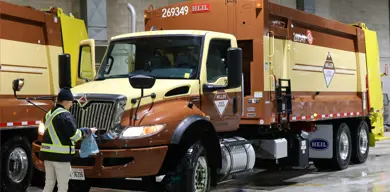

In a recent webinar hosted by Recycling Today Media Group, David LeBlanc, Corporate Systems Trainer and Solutions Specialist at Miller Waste, and John Davis, Head of Delivery for Fleet Maintenance at AMCS Group, explained how Miller Waste Systems used technology to improve fleet efficiency. They described how the move from paper, spreadsheets, and fragmented workflows to highly automated fleet maintenance management software, cutting fleet maintenance costs by 10% to 15% in one year.
Beyond the cost reduction, the Miller Waste team built trust in their data, secured technician adoption, and standardized maintenance workflows across a distributed operation.
the core challenge: fragmented data + negotiated decisions
Miller Waste Systems operates approximately 1,200 trucks across multiple Canadian provinces. With more than 2,500 employees and 200 technicians, that scale creates logistical friction for any organization evaluating truck maintenance software or trying to manage maintenance consistently across locations.
Before AMCS, Miller Waste relied on on-premises workarounds: paper logs, whiteboards, and localized Excel spreadsheets. LeBlanc said these methods left data exposed to human error and decay:
“If the data moves through too many hands, and too many people are in that spreadsheet modifying the data, the decisions you make on that data become a negotiation, and there’s no real central place where that data can live... The data is the data. You have to trust your data, and you must be able to drive enterprise-level decisions based on that.”
When facilities used different spreadsheet formulas or interpreted maintenance variables differently, corporate insights broke down. Miller Waste lacked the real-time visibility that many vehicle maintenance software platforms are designed to provide. Leadership had to piece together a “Frankenstein dataset” and lacked the metrics needed to optimize operations.
Miller Waste needed one trusted source of truth, not dozens of local interpretations.
rethinking the pipeline: from raw inputs to revenue outcomes
The goal was not to digitize broken workflows. LeBlanc wanted a reliable data pipeline that could turn daily shop activity into better decisions.
Raw data inputs → API integration → Operational outcomes
Raw data inputs: wrench time, parts tracking, and local work orders
API integration: cloud architecture, telematics fleet management integration, and automated warranty flags
Operational outcomes: 10% to 15% cost reduction, enhanced ROI, and data-driven decisions
In this framework, mechanics generate raw data through daily tasks. Cloud architecture automates tracking and aggregation, turning that activity into business results: less downtime, optimized parts replenishment, and lower costs across fleet maintenance operations.
By automating administration, Miller Waste helped teams spend less time on data entry and more time on execution and fleet optimization.
driving technician adoption on the shop floor
Technology created the foundation, but adoption made the transformation work. Implementing enterprise software across a large, distributed workforce meant addressing behavior, habits, and resistance to change.
LeBlanc managed the rollout by putting tablets directly in technicians’ hands across Miller Waste’s 45 locations. He acknowledged the friction:
“Some portion of the people, maybe 50%, are like, ‘Yeah, I love it, I’m going to take it, I’m going to run with it.’ Those are great. There are a lot of people that will resist it. That’s just going to happen with change... The biggest concern I had was the resistance, the fear that we are trying to observe them in their day-to-day, hourly basis.”
To overcome skepticism, Miller Waste avoided top-down mandates and focused on feedback. When technicians raised concerns, LeBlanc used them to identify usability issues instead of dismissing them as complaints.
The turning point came when technicians saw the system as a time-saver, not a surveillance tool. Work order creation dropped from 20 minutes to 30 seconds. The platform also gave mechanics real-time feedback: they could finish a PM checklist, see their local compliance score rise, and take ownership of daily output.
balancing system guardrails with operational autonomy
With adoption gaining traction, Miller Waste had to balance consistency with local control. LeBlanc called this the organizational “Goldilocks zone”: enforcing corporate standards while giving branches enough flexibility to respond to daily issues.
AMCS Fleet Maintenance provided guardrails for consistent truck fleet maintenance workflows across every province. It also gave shop teams the data they needed to make decisions on the fly.
This balance mattered most for preventive maintenance (PM). By linking the system with Geotab telematics, the software automatically refreshed vehicle meter readings. Instead of relying on static time intervals or manual tracking, the system recalculated forecasted PM due dates every 10 minutes based on actual equipment use. This gave shops accurate schedules to plan workloads and strengthen fleet maintenance management across locations.
the measurable impact: results by the numbers
With better data quality, adoption, and workflow consistency, Miller Waste saw measurable gains within 12 months:
Performance metric | Previous state | Current state (with AMCS) |
Overall maintenance costs | Baseline | 10% to 15% reduction |
Warranty claims volume | Manual tracking | 50% increase in claims logged |
Warranty claim success rate | Fragmented receipts | 83% success rate |
Administrative labor | Thousands of hours of manual entry | 700+ IDs |
Warranty management saw one of the clearest improvements. Previously, local shop staff tracked parts and component warranties manually, often missing recovery opportunities on smaller items.
Automated triggers tied to digital work orders now flag covered components and populate claims automatically. This reduced the burden on shop supervisors and helped Miller Waste reach an 83% claim success rate shortly after launch. With RESTful APIs, Miller Waste’s IT team can also update data across 2,000 assets in less than a day.
a journey with no end
For Miller Waste Systems, moving to a centralized fleet maintenance platform was more than a software upgrade. It was an investment in operational culture.
As LeBlanc noted, optimizing a 1,200-truck fleet requires continuous improvement. By replacing administrative friction with automated workflows, Miller Waste built a scalable model for safer, more compliant, and more efficient fleet operations.
For waste and recycling operators evaluating fleet maintenance software, truck maintenance software, or a connected fleet maintenance platform, Miller Waste shows how trusted data, automated workflows, and frontline adoption improve maintenance performance at scale.